Showing posts with label Dana. Show all posts
Showing posts with label Dana. Show all posts
Wednesday, May 13, 2009
Communism vs. Revolution
Patrick is right to agree with Caitlin, and he brings upon another important point: while these two situations are very different, one could argue that they both have similar goals to influence people to join a group. Fear is an important role in both of these situations, for they are the leading influence in the people. Generally fear is a good way to spark emotion, as we have seen in propaganda posters. Fear also implies that there is a higher power that you must follow, which is very important for the communists and the Red Guards to gain followers.

Tuesday, May 12, 2009
Bomb Drills
My mom was in elementary school during the Cold War. She remembered her school going through bomb drills every few months: her class would have to hide underneath their desks whenever a drill occurred, which seems silly to her now (hiding under desks would not provide much protection from any nuclear bombs). America was afraid Russians would them with missiles that were located in Cuba. My mother's third grade teacher would have the class pray that the Russians would not bomb America.
Tuesday, May 5, 2009

Monday, May 4, 2009
Oil
Like many others have observed, location plays a huge role in the amount of oil produced in a country. However, to question Caitlin's point (which seems to be a common theme in my blog posts for some reason), does land fertility really imply more oil? I did some basic research on oil production, and I believe that oil exported from the Middle East is derived from rocks. I'm not entirely sure what this means in terms of having the major oil-producing areas be in forested areas, but the fertility of land is not necessarily the cause of prosperous oil.
Wednesday, April 29, 2009
Kenya and Rural Life
Kenya has a whopping 34.3 million person population, and it increases by 3% every year. 80% of the population lives in a rural lifestyle, though the rural citizens of Kenya (46%) have slightly more access to improved water sources than the rest of Africa (45%). Regarding the rural lifestyle in Kenya in relationship to the rest of Africa, Kenya seems to be slightly more well off. 43% of Kenyan's have improved sanitation, while a small 28% does for the rest of Africa.
Wednesday, April 22, 2009
Children's Peace Monument Research Questions
This monument is dedicated to Sadako, a young child who died of leukemia from the radiation of the A-Bomb. The monument was based on her story; she believed that if she folded 1000 cranes that she would be healed. I was wondering if there were any other reasons for her being chosen for the monument other than her 1000 crane story. Also, the number 1000 itself seems very specific as well and I wanted to research what the number's significance to Japan's culture was. The way the monument is set up is architecturally innovative and I wanted to analyze how the structure reflected Sadako or the message she was giving. This moneument is very different than the other monuments in Hiroshima's peace park, and I wanted to discover why they made is so interactive and if that affects its fame.
Monday, April 20, 2009
Peace Park (Children's Monument)
The Children's Peace Monument is part of the Peace Park in Japan, which is located in Hiroshima and dedicated to the A-bomb victims. I chose the Children's Peace Monument (also known as Tower of 1000 Cranes, Statue of the A-Bomb Children...etc) because of its moving story. The statue is specifically dedicated to Sadako, a child affected by the radiation from the bomb. She folded 1000 origami cranes, believing that it would cure her leukemia that she got from the radiation. Unfortunately she did not get to finish her goal (she passed away because the leukemia), but her classmates finished the cranes for her and now her story is well-known in Japan. The monument is surrounded by booths filled with strings and displays of 1000 cranes that students from Japan and around the world have made in memory of Sadako and the other A-Bomb children. This makes the monument an unusual one, and involves active interaction with it to keep the story alive. However, in this article, vandalism seems to be an issue in the Peace Park, although not necessarily a threat to the Children's Peace Monument. There have been several accusations of the criminals, but no one really seems to have been officially blamed. Some say that "the culprits could be deranged and disaffected members of the peace movement itself", which seems almost out of the question. The vandalism in itself is a disgrace, but the fact that it took place in the PEACE park is ridiculous. I still don't understand the motivation behind such an action, any ideas?
Thursday, April 16, 2009
Regarding Frantz Fanon
This is a response to Caitlin's post below.
Not to be annoyingly challenging, but I politely disagree with your post. I feel that your thought of individuality and the power of distinguishing personal views from peers is a bit cliche and innocently idealistic. I agree with Fanton. I feel like people are constantly adapting to their surroundings, hence how children learn how to do...everything. It's a survival instinct. If colonization were to happen, and the colonies spread their influence all over the native land, I think that their actions and words could change the way the natives speak. Humans subconsciously adapt to their environment to survive. One example is Stockholm Syndrome. In order to survive, a prisoner gains sympathy for the higher power holding them captive. Fanton said, "Man's tragedy, Nietzsche said, is that he was once a child. . . . However painful it may be for me to accept this conclusion, I am obliged to state it: For the black man there is only one destiny. And it is white" Even Fanton agrees that the truth is grim, but the truth is indeed the truth. Even in America, citizens from other countries adapt to the American life. It's for practicality and for survival. It's human instinct.
Tuesday, March 24, 2009
Rosie the Riveter Memorial

I realize that this assignment didn't ask for memorial pictures, but I stumbled across an interesting article that talked about this memorial which is actually in San Francisco. The memorial is technically dedicated to Rosie the Riveter, even though she is a fictional character. Instead of portraying images of Rosie the Riveter, like perhaps a traditional monument would, the memorial depicts photographs of other women inspired by the cultural icon. Their words are welded into the structure and ground, for the public eye to observe and be inspired by. One older woman pondered, "'I have a deeper feeling we're all Rosies now.'' This cultural icon allowed women to gain confidence in themselves and encouraged them to conquer what they couldn't before.
The monument itself is rather modern and unique, perhaps to mirror the ideas that Rosie was stirring up. I'm not entirely sure how interactive this monument is supposed to be, however. What looks like a ladder is filled in with photographs and the overall structure is somewhat impractical. Hmmm what does that say about Rosie...
American Girl Dolls
I have talked about the American Girl Doll book series in a previous post, but I suppose now it is an actual assignment. I read these books as a young girl and basically drew a lot of historical information by learning about the main character, Molly. This particular series is based in World War II, where we see Molly encountering the effects of the war in her daily life. In one book, I believe she wants to buy a pair of yellow rain boots. Unfortunately, because of material limitations at the time, she is unable to purchase these boots. The time may have passed for most students, but these books were really fun and educational...
Monday, March 23, 2009
Rationing
Rationing in Britain was introduced in 1940 to respond to the decrease of food imports. Food coupons were used to control food consumption. There were several disputes regarding 'cheating' to get food, even though some products like eggs, butter, and meat could be easily found in rural areas. Children's needs were taken into account, however. Luckily they were able to legally receive rare goods like orange juice and milk to help their growth. The government also allowed pregnant women to receive free milk as well, given that their family earned the minimum wage or less. Soon enough, there was a report starting to be written that gave nutritional advice. Winston Churchhill did not approve of the article, however, so it was never published. Eventually the government also began to ration clothing as well, which quickly became scarce. Towards the end of the rationing phase, the annual coupon allowance was 20, but a coat cost 18 coupons.
While rationing may seem to be a good idea from an economic point of view, it is impossible to govern the amount of food and nutrition we need as individual. People will try to get what they need, whether it is legal or not. Instead of rationing food, they should encourage cultivating food so they are not as reliant on imports. That way they will become self sustaining and the people are not as likely to become frustrated and hungry.
Wednesday, March 18, 2009
nUNclear
The video from NBC seems to reflect first hand experiences of Japanese people more than the reasons behind the actual bombing. 50 years after the fact marks a moment of memorial, so perhaps the purpose was to enlighten American people of their country's actions, especially because apparently they were not even aware of the means that their country took to get Japan to surrender. I have been to Hiroshima myself a few years ago and walked through the museum and several memorials. The Japanese views in the video are represented accurately, they were very graphic with the affects of the bomb...there was even a wax display of people's faces melting off in burning scenery. I thought I'd just post a few images of the memorials I saw... it was amazing how quiet and serene the town was... (click on images to enlarge them)


Monday, March 16, 2009
Storytime in 1933-1945
This time period in general has many overwhelming aspects, it is practically a burst of insanity in a short time. It was a dense time period; obviously it involved many parties and ended many lives. By starting the the chapter by explaining the legendary figures involved, the textbook author initially humanizes a time period that could be easily broken down into a simple time-line. The textbook should be in chronological order, however. After all, this is a history textbook; While it may be more interesting, humanizing each event would also be overwhelming. If I were to write a textbook, I would write all of the events chronologically and introduce influential leaders at the beginning of the chapter. Even though many things happened in this time period, it would take away from that importance of it all if each portion were separated into different chapters (Holocaust in a different chapter than World War II).
Personally, if I were to write a book to get people invested in history, I would take inspiration from the American Girl Doll series...embarrassingly enough. I read these when I was really young and I remember a lot of unique events in the book that related to the effects of the war on the people. It's a tween concept, but easily relateable and makes history reading fun! There probably wouldn't be enough historical facts embedded into the storyline to serve as textbook material, though.
Tuesday, March 3, 2009
Art of War Longing
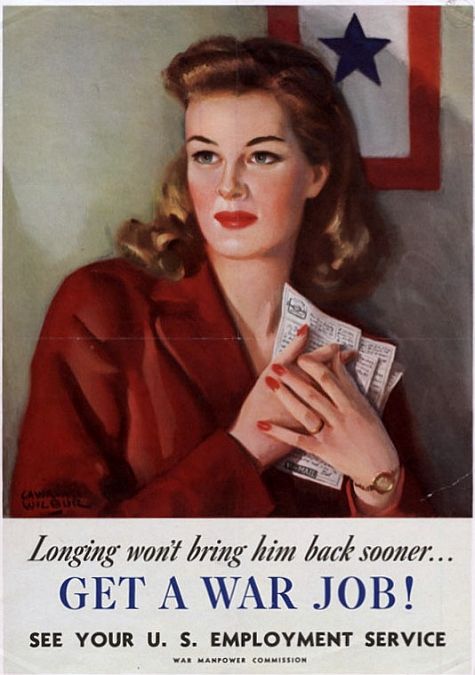
This propaganda poster is very different than what the World War I posters and the March Revolution brought up. It's purpose and message are somewhat misleading. The World War I posters used women as an icon to persuade capable men to ship off to war. This poster seems to reverse this role, now the women are the capable ones. Even though the poster empathizes with the hardships it sprung upon the women, it manages to push its cause of total war to trick women to participate in war efforts. However, the March Revolution (for Russia at least), proved that women were more worried about their own lives and rationing than the men off at war. It brings the illusion that working for the war cause will bring the men in their lives back sooner, which isn't necessarily true. Perhaps the fact that this poster is from America and the posters we studied were mostly from Europe changes perspective. Americans want to believe that they are capable and productive, which this poster encourages. It also encourages nationalism, which is perhaps most important of all during a war.
Appeasement
Sometimes my mom will say something that I completely disagree with when she drives me home from school. When I vocalize my opinion, she will try to shut me down and only say her idea. The car ride is only 10 minutes and I do not want her to follow me into my room to talk about topics I do not like, so after a few minutes I say that 'she won'. However, sometimes she likes to continue to talk about why she is right even after, which is why appeasement does not work very effectively with my mother. It is almost counter-productive.
Monday, March 2, 2009
Is a Demon Humanized No Longer A Demon?
This article discussed the reactions to humanizing Hitler from the media (The Hidden Hitler, Blind Spot: Hitler's Secretary, Hitler's Skull, etc). One man, Claude Lanzmann, found that a humanizing Hitler would be an obscenity. The most interesting quote was taken from Ron Rosenbaum (in regards to Lanzmann's reaction), "To embark upon the attempt to understand Hitler, understand all the processes that transformed this innocent babe into a mass murderer is to risk making his crimes 'understandable' and thus, Lanzmann implies, to acknowledge the forbidden possibility of having to forgive Hitler.'' Regarding 'Blind Spot: Hitler's Secretary', the reader discovers random facts that sheds new light on Hitler. The author summarizes, "She provides homey insights into his personal idiosyncrasies, like his refusal to wear shorts because his knees were too white and his affection for his dog Blondie, trained to sing in two octaves."
Initially, I found these facts a little unsettling. Generally I like topics that humanize history, but this article made me uncomfortable. However, while the secretary's insights certainly humanize Hitler, the relationship to his horrible actions are weak. There were some hints that Hitler was a reppressed homosexual or that he was mistreated as a child, but those don't really justify his actions.
Wednesday, February 25, 2009
Faith and Fear
Faith and fear. These are relatively vague terms, but seem to be the underlying aspects of both Maus and the Price of Going to Class. As an atheist and a young person with little experience regarding life threatening decisions, I find it hard to even relate to these two experiences. I don't even know if I would be strong enough to stand by any 'belief' I may have. Would I be willing to endanger my life to keep whatever remains of my lifestyle, or more importantly, would I be able to cope with the guilt of caving in?
In Maus, Vladek constantly relies on his strong will to live. He is surrounded by weaker people, such as his depressed wife and fearful mice. In one scene a fellow mouse even betrays Vladek by ratting out the location of the bunker to the cats, which seems awfully repulsive on paper. Even though Vladek is at the direct mercy of the cats several times, he always manages to understand t hat he will live through it. Vladek should be respected for his level-head that many other mice seem to have lost.
This brings me to the article from Upfront. While Menlo students count the minutes that their teachers are late, in hopes that they will get a free period instead, girls in Afghanistan cannot even legally attend school. In the article, the Price of Going to Class, Shamsia Husseini still secretly goes to school. She does this with pride and for a good cause, however. In regards to the supressive Taliban, Shamsia stated, "The people who did this to me don't want women to be educated. They want us to be stupid things." She refuses to be held down by the Taliban, just like Vladek refused to be taken over by fear from the Nazis.
Even though we have the privilage of attending a great school, many of us lose sight of this opprotunity. While I understand that we will probably not be in the same position as Vladek or Shamsia, these stories help us gain perspective and take advantage of what we are given.
Subscribe to:
Posts (Atom)