Showing posts with label Irina. Show all posts

Friday, May 29, 2009

D Block MWH with Mama Pugs :)

D Block MWH was like no other class. It was a class I always looked forward to. It was a class in which people expressed their thoughts and opinions . It wasn't just a class were you sat down and took notes. Ms. Pugliese provided us with more engaging ways to learn the incredible amount of material we learned in such a short amount of time. There's one very important thing I took from this class. This is the ability to write a proper essay, not like the ones I wrote freshman year but to-the-point, argumentative, and connective essays. There's one person I should thank for this. It's Ms. Pugliese. Whenever I was stumped on how to begin or end an essay, she somehow always managed to help me succeed. 
This class provided us with different ways to express our knowledge of Modern World History than just memorizing important information and taking dreadful tests in which you had to analyze each multiple choice question in order to be able to answer it.  The idea of having a blog was genius. It allowed me to truly express what I felt about a certain issue or certain events and it also helped me think and connect certain issues with events from modern times. 
D Block MWH with Mama Pugs was MUCH more than just a plain old history class.

Wednesday, May 13, 2009

Out with the Old

After reading both passages, I found out that they were very similar because both passages had a main theme of revolution, reformation, and going against the old order. The passages managed to display this specific theme in different ways. The one page 766,  had peasants against the "political forces." In the article on page 769, it was youths  (proletariat class) going against old Chinese culture. Both of the social classes in the passages went against the old order completely. 
 
One thing I found was different was how hesitant the peasants were to go against the old order while the proletarians (Red Guards) went at it and started destroying things of old Chinese culture immediately. The peasants fear to speak out against Kuo Te-yu in the first passage was probably because all their lives they have been living in poverty and when they finally had an opportunity to go against the government, they didn't know what to do and weren't confident. On the other hand,  perhaps because the proletariat class was on a slightly higher level than the farmers (peasants)  they didn't feel restrained and were able to go against the old order without hesitation. 

Tuesday, May 12, 2009

Cold War....BRRRRR

When I interviewed my mom, she did not know exactly what I was talking about when I mentioned the Cold War. On the other hand, my dad said he knew what it was and that it was going on, but he didn't really care so much at the time since he was a teenager. He said that Romania wasn't part of the Cold War but since the Romanian government was communist, the government sided with Russia. My father, however,  said that he  liked American government and despised  communism. An interesting thing he told me was that he remembered there being a radio station that was called "The Voice of America" and that it  was illegal  to listen to this station and those that did listen to it, were sent to jail (If someone told the cops) since it completely talked smack about communism. 

Monday, May 4, 2009

Oil !!!

As we can see from the map in our textbooks, the majCheck Spellingor oil-producing areas are surrounded by water in this case, the Persian Gulf and also the two major rivers in the Middle East (Tigris and Euphrates). Also from the topographical map we can see that the major oil-producing areas are where there is low altitude (near water). We can see why Iran was one of the richest countries in the Middle East as our textbook mentioned. It was a major oil-producing area. Yes, oil did lead to many conflicts and instability in the middle east, this instability usually came from outsiders who tried to take over the oil reserves. The money oil helped people in the middle east gain, lured many outsiders which led to increased conflicts within the middle east. Even internal invasions occurred in the middle east. In 1190 Kuwait was invaded by Iraq. How come? Perhaps because Kuwait is a major oil-producing area. 

Sunday, May 3, 2009

Post-Colonialism and Culture

A Thousand Splendid Suns by Khaled Hosseini:

This novel takes place in Afghanistan during the last 33 years of war within Afghanistan. This book is written and told  through the lives of two woman named Mariam and Laila that never had a chance to experience happiness living in  environment where there danger stood on every corner.  I don't want to give away too much, but this novel was definitely a page-turner. 


Things Fall Apart by Chinua Achebe:

Just recently, I finished reading Things Fall Apart. The novel was set in Nigeria in a village called Umofia. The main character was named Okonkwo. He was very manly and feared showing any emotion. He always tried to be perfect and tried to maintain his great reputation, but in the end, he lost control of his thoughts and actions when European missionaries invaded Nigeria. 


Wednesday, April 29, 2009

Nigeria and Education

The population of Nigeria is 131.5 million. The literacy rate in Nigeria is greater than the WHO African Region literacy rate. It is said that out of 131.5 million people, 66.8% are literate, while only 60.1% of the WHO African region is. When it comes to comparing men and women education, men have a 74% primary school enrolment ratio, which is significantly bigger than women that have only a 60% primary school enrolment ratio. 

Wednesday, April 22, 2009

Arc de Triomphe?


My Questions About the Arc De Triomphe:

Does this monument provide an impact for people today? In what ways? 
Did it provide more of an impact on people in the past?

In modern times, how has the monument been described? 
What opinions do people have about the arc?

How has its meaning and significance changed over time?

Is there a particular reason why its situated in that specific spot?

What's is the significance of its shape?

What's the history behind the monument? 

Whose names are inscribed on the inside of the monument? Why are they inscribed there? In other words, why are those individuals so significant in French history?

Explanation:

I have a wide variety of questions that, I believe, will help me answer the fundamental question, "What's the significance of this monument for France?" I can then use the answers to create an argumentative essay about perhaps how this monument symbolizes French Pride.

Sunday, April 19, 2009

Arc de Triomphe

Arc de Triomphe (Paris, France)

The Arc de Triomphe is a famous monument located on Champs Elysees Avenue in Paris, France. This monument honors those who fought for France in the Napoleonic Wars. Under the arc is a tomb of an unknown soldier from WWI, who was buried there in 1920. This arc was designed by Jean Chalgrin in 1806. Napoleon commanded him to build an arc that was to represent the glory of the French army. Since Napoleon admired Roman empires, following the example of a famous roman arc, Napoleon decided to build a monument himself for France. Construction began in 1806 and was only completed in 1836. 


Websites:

Since I've never been to Arc de Triomphe, I was interested in what people had to say about their experience.
Interesting website ... people provided reviews on the Arc de Triomphe:

After reading the reviews, I found out that most people had excellent things to say about the arc. Some said they liked the architecture while others said they liked the view from the top. Although the Arch is so amazing, there is one thing the people that left bad reviews are concerned with; the traffic around the arc is so dangerous and its really hard to drive around it and it destroys the peaceful nature of the statue. Frustrated by this, a very few people gave the arc bad review. However, there must be a reason why its at the center of attention. Perhaps it represents French pride and glory because of the many names of war generals inscribed on the inside of the arc. In the picture below are the names inscribed on the inside of the arc. 

Wednesday, April 15, 2009

Dinesh D'Souza... Religion


Dinesh D'Souza was born on April 25, 1961 in India. He is a writer and a public speaker. His most recent book, "What's so Great About Christianity?" led to a lot of discussion and debates about religion. In his book, Dinesh tries to proves with facts why religion in still believable with new scientific discoveries occurring. I recommend you watch this video to gain a sense of D'Souza's point of view in one of his debates. 
I found this video very interesting and hard to argue without being bias (which is the only way to go, unless you have proven facts). The questions "where do we come from?" and "where are we going?" are answered by the many religions in the world. The only problem is which one is right. There is no fixed answer to the two questions above, but religions provide answers we can choose to believe in.    In this video D'Souza tries to explain the very controversial issue of religion in his opinion . Even thought he doesn't touch on every aspect of the questions presented, he does a good job in explaining the idea of "suspend[ing] your disbelief until you evaluate something critically."    This I believe is a good point that is merely saying "don't judge a book by its cover." You shouldn't judge something before you  have experienced it. After you experience that specific religion, then you can decide if it fits your worldview or not. 
From this video, we can see that D'Souza  finds  the worldview of an atheist to be illogical.What I find interesting and perhaps controversial is how D'Souza describes an atheist's belief about religion..."There's ten of them (religions) and they can't all be right, so Ill choose none of the above."  I'm not sure I understand exactly why he believes the worldview of an atheist is irrational, but he does bring up some interesting points in this video and perhaps I would like to look at the book he has written to learn more about his opinion. 

Monday, April 13, 2009

"If You Give a Mouse a Cookie"


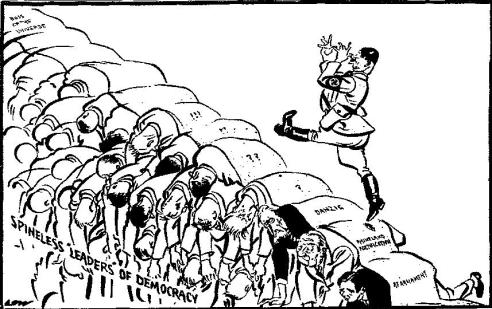
Hitler walking on spineless leaders
This political cartoon by David Low, depicts how Hitler was able to reach his goal by stepping all over the "spineless leaders of democracy" that appeased him. 
The are many interesting elements in  this cartoon. The first component that strikes me is  how  people like Neville Chamberlain the British prime minister that appeased Hitler were described - "spineless leaders of democracy." Another thing I saw was the carpet laid out for Hitler as he ascended the ladder of "taking over the world." In this cartoon Hitler is thumbing his nose, which is a sign of disrespect. Disrespect and Intolerance is exactly what he showed as he planned the murder of innocent people that he "believed" were "in his way and out to get him and destory his perfect world."
 This cartoon illustrates a point. Hitler was able to reach his goal from the results of appeasement. If you give a mouse a cookie, he will probably ask you for some milk. If you give Hitler Germany, he will probably want to take over the world. 

Tuesday, March 24, 2009

If Rosie Can "Do It," So Can I

Throughout the course of both wars, there were numerous propaganda posters which publicized the war and encouraged people to achieve certain things. In WWI, propaganda posters like this one portrayed women as feeble and helpless. Other posters only publicized the abilities of men and what effect they could have on their nation. We see a major shift in the way women were treated and thought of in WWII propaganda posters. One very famous propaganda poster that displayed the female character "Rosie the Riveter," invented by Redd Evans shows the significance of women during WWII. As men were drafted into the military, women remained on the home front which had many jobs available and left behind by men. The posters of Rosie the Riveter encouraged women  to be part of the work force by telling them, "We Can Do it" and showing them that men are not the only powerful and strong ones. 
Now men in the army had women working with and for the war in factories creating weapons and military supplies. Everyone was part of WWII and women were now open to more opportunities and given a greater role in society and a greater sense of belonging to  their nation. Therefore, women had a stronger role in the second World War than the first which can, in some way, be seen from the shift in the messages propaganda posters were conveying. 

History in Media


Movies:
Valkyrie- A recent movie that is set in Nazi Germany during the time of WWII. It is about German officers planning to murder Hitler and take control of Germany. 

Cabaret- A musical that is set in 1931 in Berlin before the Nazi's came to power. In this scene an "Aryan" German boy is singing a song called "Tomorrow Belongs to Me" while other Germans join him. 

Books:
The Sunflower by Simon Wiesenthal- This book, which takes place during the Holocaust is about a man named Simon that is incarcerated in a concentration camp. One day, he is taken from his labor and taken to the hospital room of a dying Nazi soldier that asks him for forgiveness for what he had done.

The Diary of Anne Frank- was a book based on a girl named Anne Frank's life during the Holocaust. She and her family hid from the Nazi's in the attic of her father's office building. 

Monday, March 23, 2009

Gas Masks

After Hitler came to power, the British government didn't know what would follow to. In fear of chemical warfare used by the Luftwaffe-the German air force- the government provided gas masks for British civilians in 1939. For nearly a year, these gas masks were used by 75% of "Londoners."
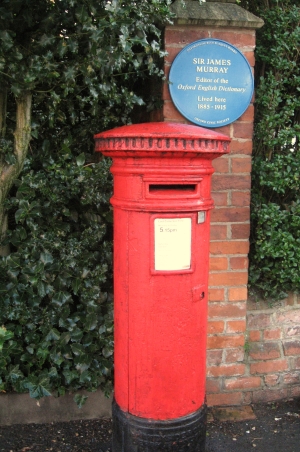
Although the government might have frightened its civilians with talk of chemical warfare, this, I believe, is what made people obey the government's new rule- that all citizens must wear the gas masks when they were outside. In frightening civilians about poison gas and distributing the masks unfairly, this created commotion because the people that did not receive the masks worried they would be in danger of being killed by poison in the air. Because the government did this, I believe it really cared about keeping its civilians and maintaining population. The fact that the government punished those that misplaced or broke their masks by making them pay for the masks only supports that argument as well as the fact that Air Raid Wardens (group created by government) conducted monthly inspections of gas masks. Post Office pillar boxes were given a new coating of paint that would detect  gas. This made it easier for Gas Identification Squads, which were a group of chemists, to see if the gas in the air was poisonous. The fact that the British Government enforced that people wear this mask, show that they wanted to protect their people. I don't think that the British government should have inflicted greater punishment on the people not carrying their gas masks because if the people wanted to save their lives, they would have listened to the government because all it was trying to do was protect its people from somewhat avoidable death. 

Tuesday, March 17, 2009

Pride in Destruction

The people of the US were assembled in an immense crowd that acclaimed Japan's surrender in WWII. It was something to celebrate at the time because the US could have been in the place of Japan and completely destroyed. What I find heinous is the ignorance of the US civilians (at the time) on what exactly dropping the atomic bomb did to Japan. All they did was celebrate and take pride in the victory of the US. Had something like that happened to the US, civilians would not act so gratified about their actions. The bombing extremely affected the people's lives and still significantly has an impact on people now. I believe NBC decided to air this piece in 1995 because they wanted to show the US's rationale and explanation as to why the bomb was dropped since so many people are questioning and finding what the US did was very inconsiderate and what not.  

Monday, March 16, 2009

The Effects of Dictatorial Regimes (WWII)

I believe the way that the information about WWII in the textbook is organized, is the more effective and simple way to display the information. Chapter 24 has a great start, discussing totalitarianism and introducing us to what regimes were imposed at the time. Then we are introduced to the rulers of the time period and what they did with their power. 
Instead of mixing up  the information about all the countries into one large story, the author of this textbook chose to create mini stories; each one telling all the information about that specific country. The author told each side of the story of WWII from each countries perspective. This method of writing, I believe, makes the info easier to take in and learn. 
YES, I do believe that making the Holocaust a distinct section was a good idea because that way, it is separate from everything else and this shows the significance of that period in history and makes the reader pay more attention. The information about the Holocaust being displayed in story form  ( information is mixed together and put into chronologicalorder  like a time line ) would have not been as effective and would have been too much to handle at once. 

The title of my chapter would be The Effects of Dictatorial Regimes (WWII)

Thursday, March 12, 2009

Drafted


This information came from my mother... this is as much as she could tell me about one of our relatives that fought in WWII. 

My great grandfather, on my mother's side of the family, was drafted into the army during WWII. The regime in Romania forced men to join the army and fight on Germany's side. Then, after a period of time, Romania finally joined the Allies when King Micheal came to power and Ion Antonesu's dictatorship was brought to an end. Interestingly, my great grandpa fought on both sides during the war. I don't know any other specifics, but my mother told me that she heard that when her grandfather came home from the war, he was extremely skinny and was not the same person anymore. 

Tuesday, March 3, 2009

Appease the Little One... or else

Appeasement. Very popular in my life. Especially when it comes to getting into fights with my eight year old brother, who usually wins because he's the  "innocent little one." (according to my parents) I'm sure those of you with little siblings might know what I'm talking about. In order to avoid future conflict like, for example, my brother ripping my homework or stealing my "valued items," I tend to let things go his way... sometimes. Going into chemistry class and saying "my brother ripped by poster board" won't serve as a good excuse to getting an extension/ another night to redo my work. Therefore, I tend to agree with him on certain issues and avoid making fun of him in order to avoid future conflicts like him stealing my phone to play games and dropping it on the floor. It might sound lame that my little brother wins, but he does anything to get revenge, and he does it in the blink of an eye. 
Although these events occurred when my brother and I were younger, sometimes I still have to appease him in order to avoid sad consequences. But now, I show him who's boss. 

Monday, March 2, 2009

The Solution to Reconstructing Germany

Although Hitler was born into a very poor family and had a
troublesome love life, he started showing leadership ability from a young age, and was
able to gain enough power to get people on his side and destroy innocent culture. 
The article I found on Adolf Hitler is from the April 13, 1998 issue of TIME Magazine.  The author, Elie Wiesel, explains that Adolf was pure evil and a madman with cruel intentions. She uses an interesting word to describe Hitler. She says that Hitler had a hypnotic gaze, which I believe is true. Hitler's hypnotic gaze, is another way to say that he gained followers (by hypnotizing or brainwashing them). I believe the people of Germany were so torn down by WWI, that when Hitler came to power, the only thing that would raise them back up was this leader, Hitler. Little did they know at the time, since people were so desperate for help, that this man - with a troublesome life- would completely destroy anything that stood in his way to becoming powerful. 
Like Wiesel said, the people did not see the cruel intentions hidden under Hitler's passionate speeches. It was not the people's fault although they did make him powerful by supporting him. He completely brainwashed every one of "his" citizens. And as I stated before, people truly believed that with Hitler they could reconstruct the broken pieces of Germany. I also agree with her main point that Hitler redefined the word "evil" by his despicable actions and decisions. This is evident in the lasting impact of his actions on people today.

Wednesday, February 25, 2009

The "PRICE" Innocent People Pay

Life is precious and meaningful, but in the cases we've read about this week -- the Holocaust and Afghanistan - there appear to be very inconsiderate people that go as far as destroying other people's lives for their "benefit". 
"The Price of going to class," (an article in our current Upfront issues) written by Dexter Filkins displays the "regrouped" members of the Taliban's extremely harsh treatment on Afghanistan teenage girls. In the article a seventeen year old girl named Shamisa Husseini was sprayed with battery acid by a man. She was not the only woman attacked, many others were. And for what reason? What did these girls do? They were  just living their lives and going to school to learn like we do everyday, and because of this, they were attacked by the Taliban.  Throughout the article we are able to see Shamisa's strong eagerness and willingness to learn - even after the battery acid incident.  (She continued to go to the Mirwais School for Girls). It's incredible the way she and the other girls that got attacked are standing up for what they believe in and going against tradition and finally realizing that they deserve to live better lives and be treated the right way. 
I believe the answer  to why the Taliban did such a thing to those innocent girls is clear. They wouldn't allow girls to get an education because they feared loosing power. If people were more educated (80% of the women in Afghanistan are illiterate) they would rise up against the Taliban and see that they're missing out on their own rights. (They would go against the Taliban and tradition)

There was another group that suffered greatly and this was Jewish people during the time of the Holocaust when swastika flags and khaki uniformed men - the German Nazis - created chaos in Germany and other unfortunate places in Europe. 
In Maus, Vladek, a Polish "mouse" is telling his life story about his horrible life during the Holocaust. From his story I am able to say that the Nazis were a fascist group. First of all, they were a single organization in Germany that quickly became more and more powerful. (We know they became more and more powerful because they started off being guards and asking people for their "papers" then they took away businesses and finally killed anyone standing in their way) The Nazis eventually became a totalitarian group that controlled everything. Because even Jewish people - the Nazi's target - joined the Nazis, ( to avoid being killed) I believe that it grew into a popular movement. The Nazis were also very militaristic because they had SS guards throughout Germany. They also made everyone conform to their beliefs by force. All these factors are key elements of fascism.
Both organizations are very greedy and did whatever it took to gain complete control over society. When one has power, one does anything to assert one's power. These people abused/are abusing the power they had/have.