Friday, March 6, 2009

A Different Kind of Punch?

The first propaganda poster I saw immediately struck me as different than ones we have seen previously from WWI. It said "Keep punching... every day!" with a picture of a burly man hitting a man that looks suspiciously like Hitler and a man punching in at a time slot for his job. This WWII poster is much more outright violent than the ones I saw from the earlier time period. It actually shows physical harm towards the enemy, when before it was much more focused on the American troops and what we needed help with. I think a partial reason for the shocking depiction of Hitler being punched is because America had just been through a horrifying, grand war. Violence could not be hidden from the public because soldiers had come home and had spread their terrifying war stories. Also I believe that there is violence shown because Americans really were upset about their opposition this time around. There was great dislike for Hitler and the Nazis late into the war and it made people angry. Whereas before, it seemed that America was just dragged in because it was a world power. This poster was supposed to lead people to think that if they punched in hours, it would be a direct hit towards Hitler and the Nazis and I would think it was effective.


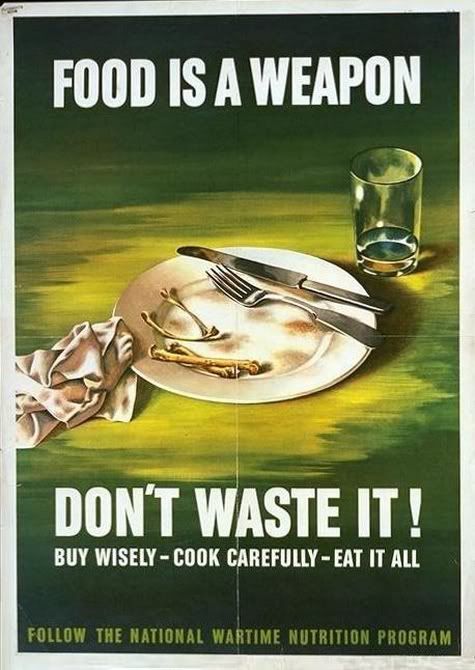
Propaganda Poster


This propaganda poster is similar to the ones we looked at earlier this year for WWI. Similar to WWI, they are trying to get the people of the United States to do something. Unlike the ones for WWI though, they don't want people to join the war, but rather eat more rationally and follow the war time nutrition plan because food in scarce during WWII. It says that food is a weapon because the more food that a country has, the longer the people of that country can survive. This is true because if the enemy has a lot of weapons such as guns and cannons, but there mine are starving, their men won't be able to fight because they don't have the energy. If they don't have the energy, they won't be able to operation the machinery and therefore all of the guns are useless. I personally don't think that this is the most powerful propaganda poster, because it doesn't show anything dramatic such as what will happen if you waste food or the success you will have, but rather just a plate of food in which someone ate all of their food. This doesn't show the effects of what happens when you finish your food. The only thing good the pictures shows is fairly nice silverware which shows that if you eat all of your food, you will keep some wealth. I do think however that the words are very effective.

question to everyone

I've noticed that most people bring up negative aspects of appeasement if your the mouse. Can it be good? Is there a point where being the mouse can be good?

Thursday, March 5, 2009

Appeasement

We all at some point have probably used appeasement to get someone off of our backs. Unfortunately, appeasement is slightly different than a compromise, in the sense that the person who is doing the appeasing gets nothing in the deal. In a compromise, both people agree on a set condition and go on their way. Personally, I've seen that when I use appeasement as a way to get my parents off my back, and this may just my imagination, but I have found that they tend to ask me for a lot more favors. When I make a compromise with them however, it seems as though we just forget about it and it goes on a lot smoother. A specific example of appeasement is if I ask my dad for 10 dollars to buy food. I continue doing this until he finally decides that he's not giving me any more money. Then I get to ask, "Why the sudden change?" Fortunately, I haven't had many experiences with both of these, though I'm sure it is much more a part of the life of someone who has siblings.

Appeasement: One Winner

Before, on Robert Wicker's piece on appeasement, I said that appeasement=constructively kissing the ass of a threat. Now of course this may not be true for all occasions, but I feel that most appease for this reason: the one whom they are appeasing has some role in their fate. The family dynamic is one filled with compromises, but for the children, their appeasing begins around the dawn of teenage life. As a teenager, we are inclined to test the boundaries of "adult-hood," even though we are still adolescents. To get what we want in our secluded island of highschool, girls (or boys, or neither, or both,) parties, friends, we must appease the higher powers in our life in order to continue down the road of getting what we want. In the short-term, the appeaser rarely receives anything back, and is left empty handed. However, in the long-term, the appeaser, with enough appeasing, may get what they wanted, and possibly more. Or to be a little more frank, by kissing a lot of butt, the appeaser will always have it their way. I choose to have a balance of compromise and appeasement, for I feel too much appeasement leads to weakness, vulnerability, and the chance of being taken advantage of.

Appeasement, A Mouse, and a Cookie

While at times, appeasement can seem to be the best option, especially if the potential consequence for not giving someone the thing that they want is a world war, in some cases, as in the case of Germany, it is almost better to assert your power and say no, before you become helpless under the power that you have given them.

This can also be seen in the book If you Give a Mouse a Cookie. Had the boy said no to the mouse and then taken the dislike from the mouse, he might not have had a big problem. Sure the mouse could potentially eat your house down from the inside out, once you get rid of him (probably with the help of an ally; a cat (possibly France) or an exterminator (the U.S.A.)) then your problem will be over, sure you may be a few dollars down, but there would be no mess in your house and you would then get to enjoy two delicious cookies with two glasses of milk.

Instead of taking Germany out as soon as they started to create their air force, or when they started to build up their army, then they would have put down a weaker opponent than after they have given them this military power and positioning. Once the other world powers allowed them to get a few things, air force, army, and the Rhinelands, then it becomes increasingly hard to say no, one because they could say well you gave us these, and the other because they now have an army, air force, and more land. Unfortunately this becomes a tragic cycle until they have so much power and want something so ridiculous, to the other countries, that now a bigger problem will erupt.

It is important to look at what the other party is getting and wether it is a better choice than if they had not given it to them. Although there are times when just giving something is a better choice, because of creating better relationships or stopping skirmishes, when in the long run, a whole bunch of seemingly little things build up and cause an even bigger problem than before, it is hard not to regret your decision giving them that first thing.

Appeasement

Life is a constant battle of appeasement with superiorities as well as yourself. We use appeasement because we fear the punishment of direct confrontation. Most days I am given advice from a coach that I view as either invaluable or either just straight wrong. But, as coach, they have the right to preach their own strategies, whether it differ from what you, as a player, have been taught by a personal coach or someone you believe in. Instead of arguing with them and earning a punishment, a few progressions perhaps, we give in to their suggestions. This has happened to me quite frequently, but instead of simply giving in to their incorrect advice, I only follow their instructions for the next few minutes. While not totally appeasing the situation, I do enough to avoid punishment and/or delay myself from developing an incorrect and unhelpful habit.